The question
In nature, a few informed individuals can steer an entire group. Reebs showed that a minority of knowledgeable fish can set a school's foraging route. Seeley found that about 5% of a honeybee swarm guides it to a new nest. Couzin et al. showed that a small group of leaders can drive consensus even when their preferences differ. We asked what happens when the followers aren't identical, and each passes along what it hears with different levels of trust and accuracy.
The model
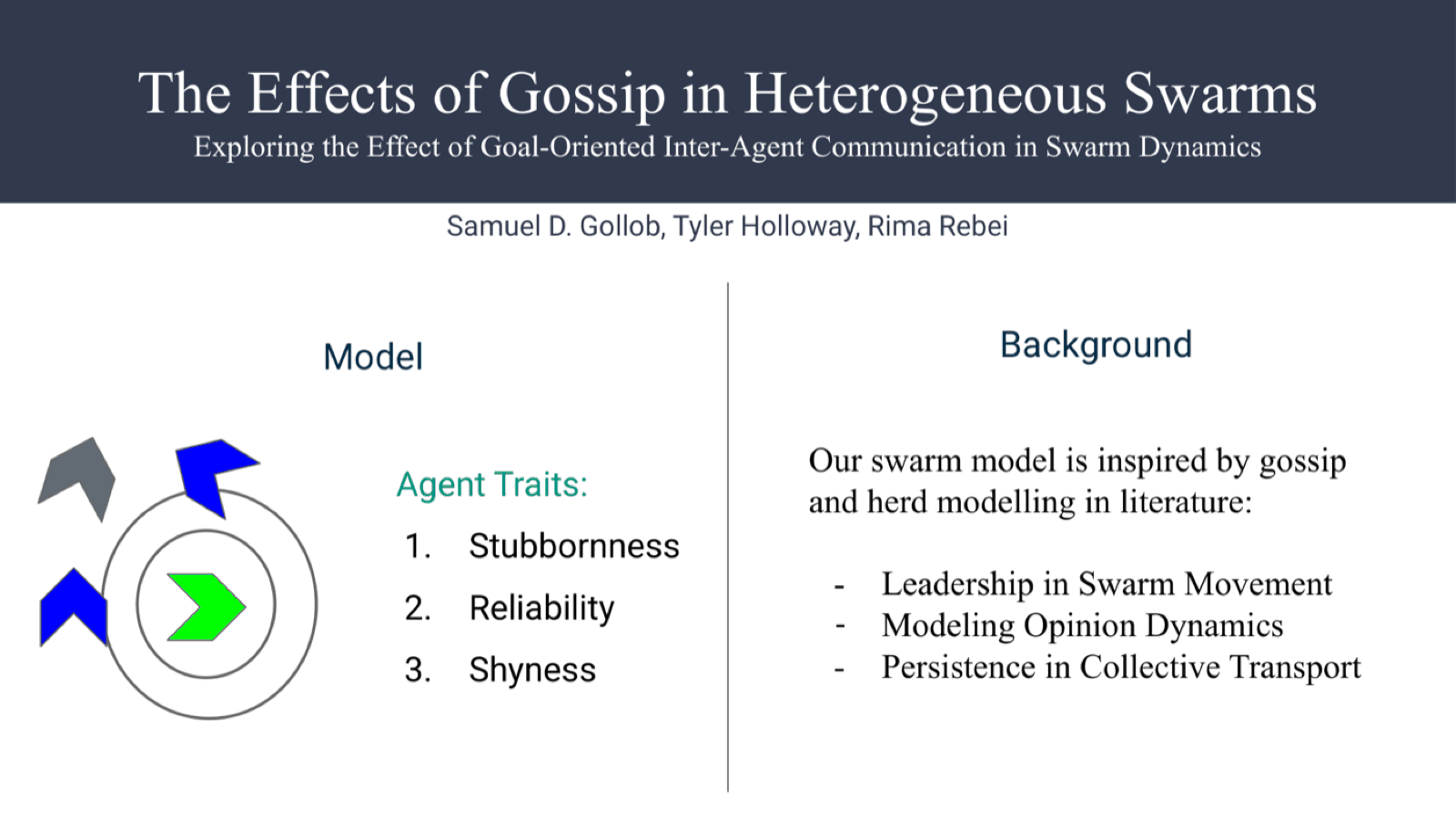
Agents start static, and an agent's "opinion" is its heading in 2D. Seed agents broadcast a target heading, and the rest gossip it to their neighbors. Each agent has three traits:
- Stubbornness: how far it rotates toward what it hears. At 0 it adopts its neighbors' message, and at 1 it ignores them.
- Reliability: how accurately it relays the message, modeled as noise added before retransmission.
- Shyness: how willing it is to gossip and how many neighbors it tells.
We layered this on the alignment rule from Reynolds' flocking model and compared runs with and without it. The extension added a moving flock, with a target position plus cohesion and separation rules. We also explored an agreement score sent with each message: it captures how consistent an agent's incoming signals are, so confidence can spread through the swarm along with the heading.
Visualization
The simulation was built in NetLogo, starting from its Flocking and Rumor Mill models. Users choose leaders and a target direction, then watch the "rumor" ripple through the swarm as agents turn. Two live plots track:
- Rumor spread: the percentage of agents who have heard the target
- Successive differences: how far apart agents' headings are, which shows convergence
A per-agent timeline shows who each agent talked to and whether that exchange changed its opinion.
Background
- Leadership in animal groups: Couzin et al., Nature 2005
- Opinion dynamics: Galam & Cheon's tipping-point model, with agents that differ in stubbornness and contrarianism
- Consensus in collective transport: McCreery et al., 2016. Consensus needs both a tendency to align with the majority and a directional bias.
- Gossip protocols in distributed systems: Kermarrec & van Steen, 2007