Motivation
Duchenne muscular dystrophy (DMD) is one of the most common genetic conditions, affecting about 1 in 3,300 male births. It weakens every voluntary muscle over time, but even in severe cases people usually keep small head movements and facial expressions. Life expectancy for people with DMD keeps rising, yet most wearables are designed for rehabilitation rather than everyday tasks. Eye-signal (EOG) control systems also tend to be bulky, expensive and hard to use.
This project combines two inexpensive signals, optical flow from a head-mounted camera and EMG from the eyelid, to control a full robotic arm-gripper system.
Wearable design
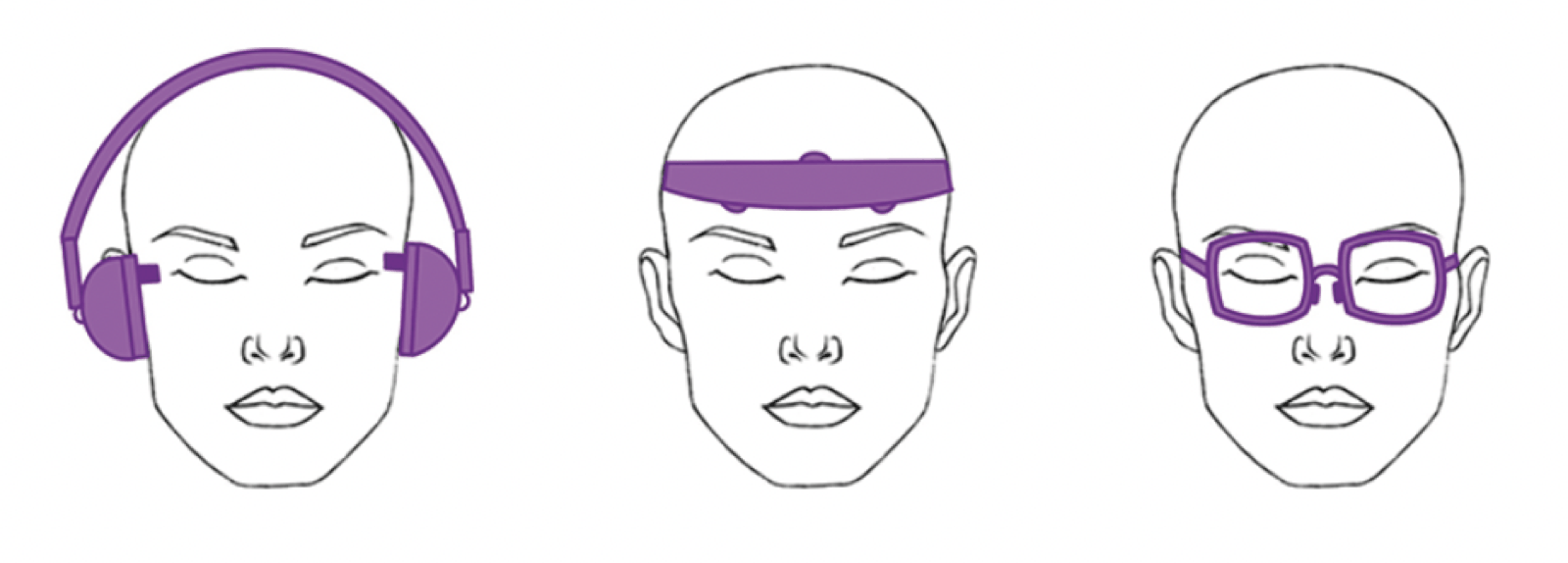
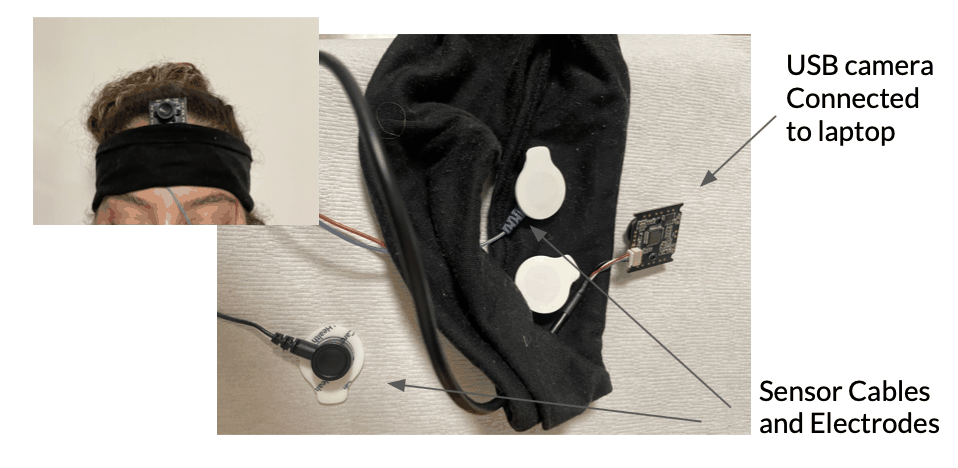
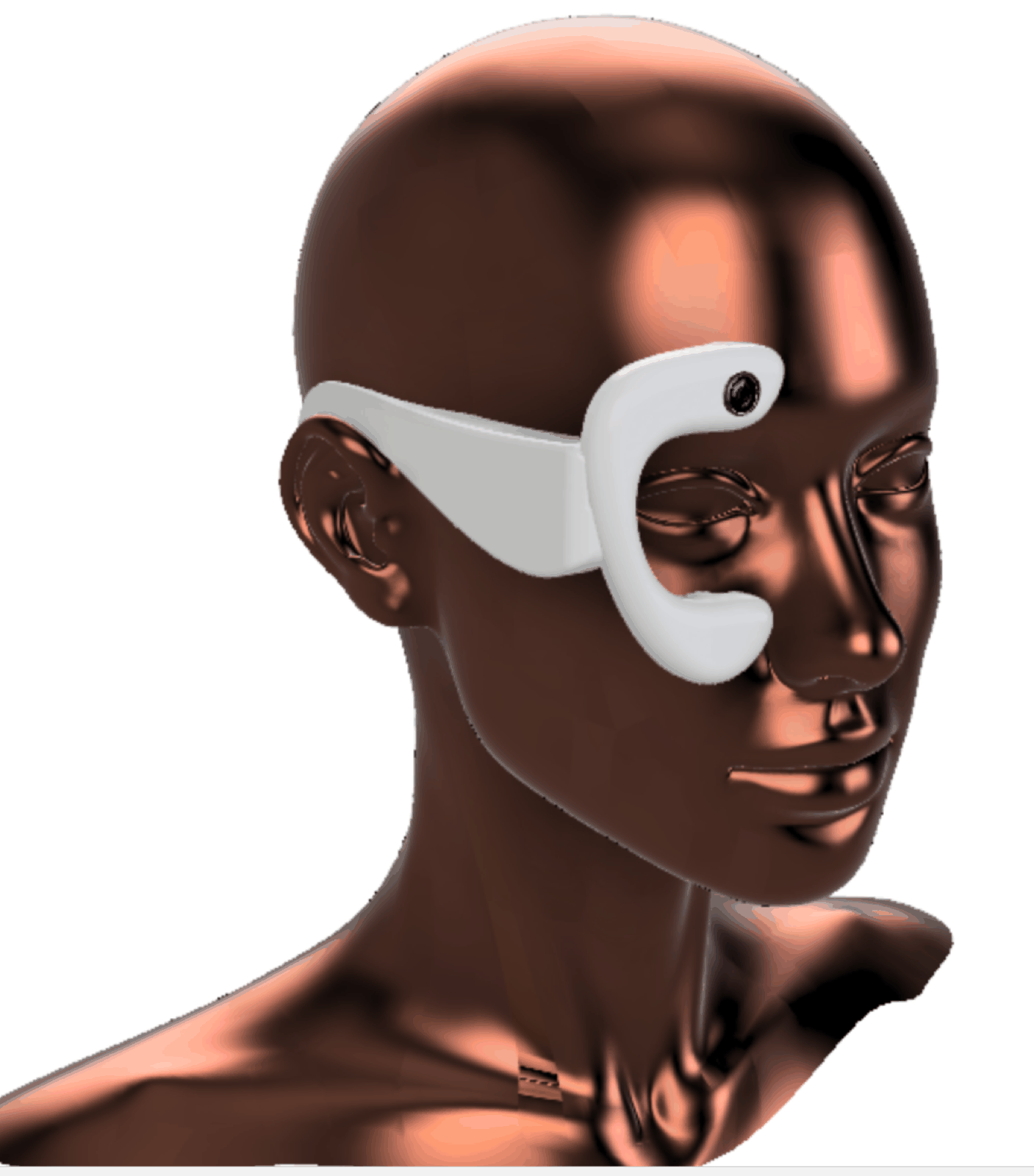
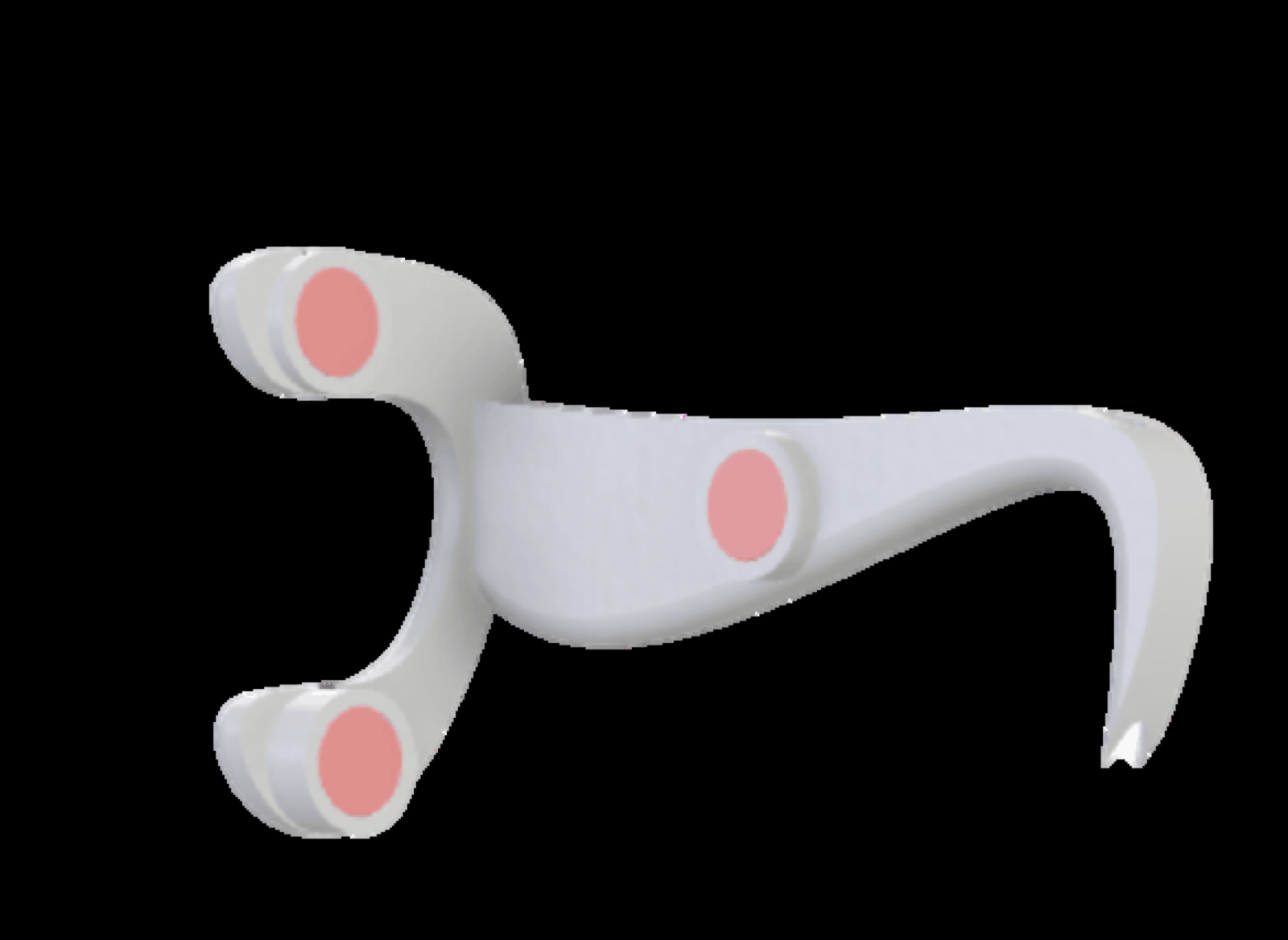
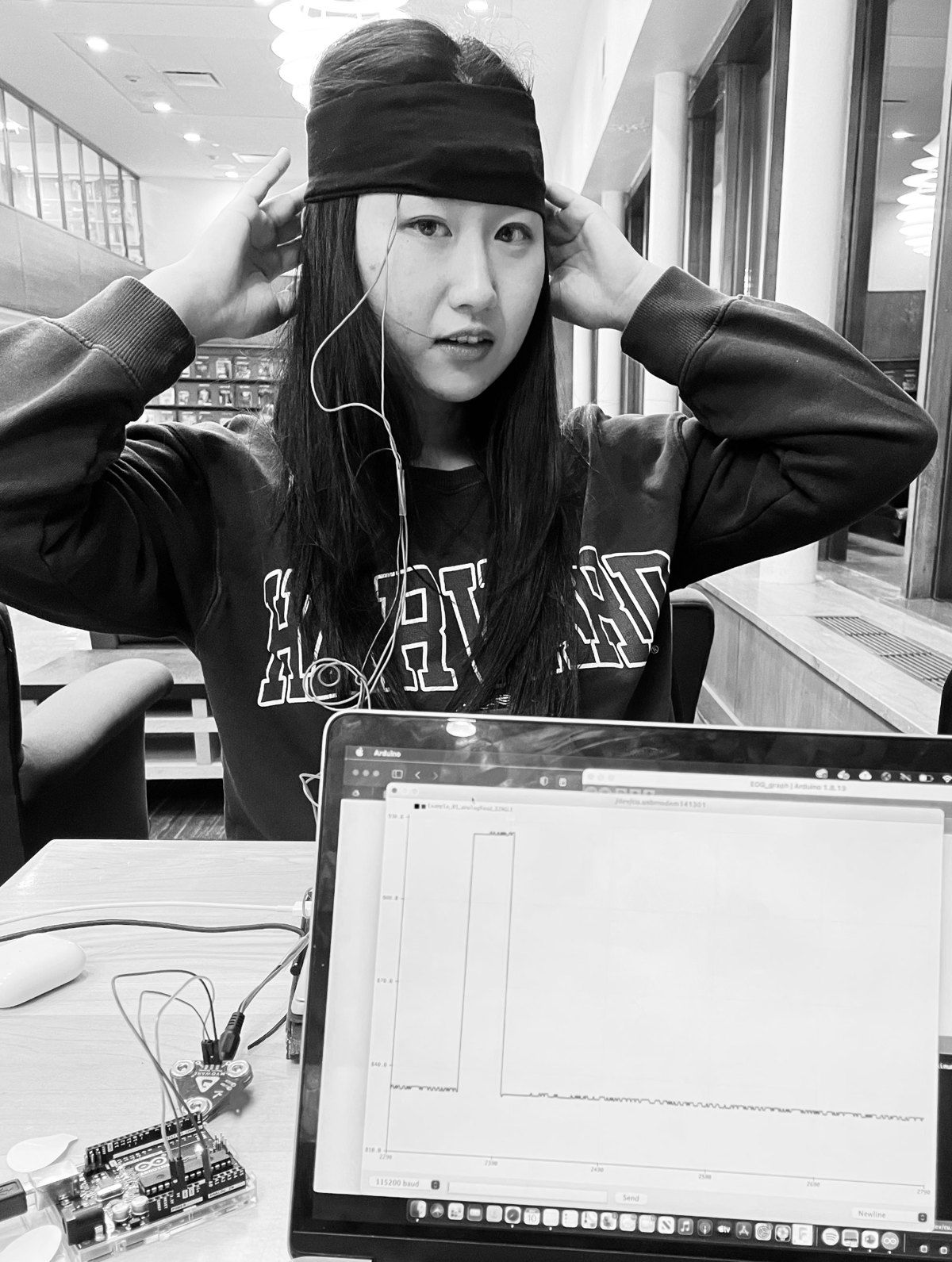
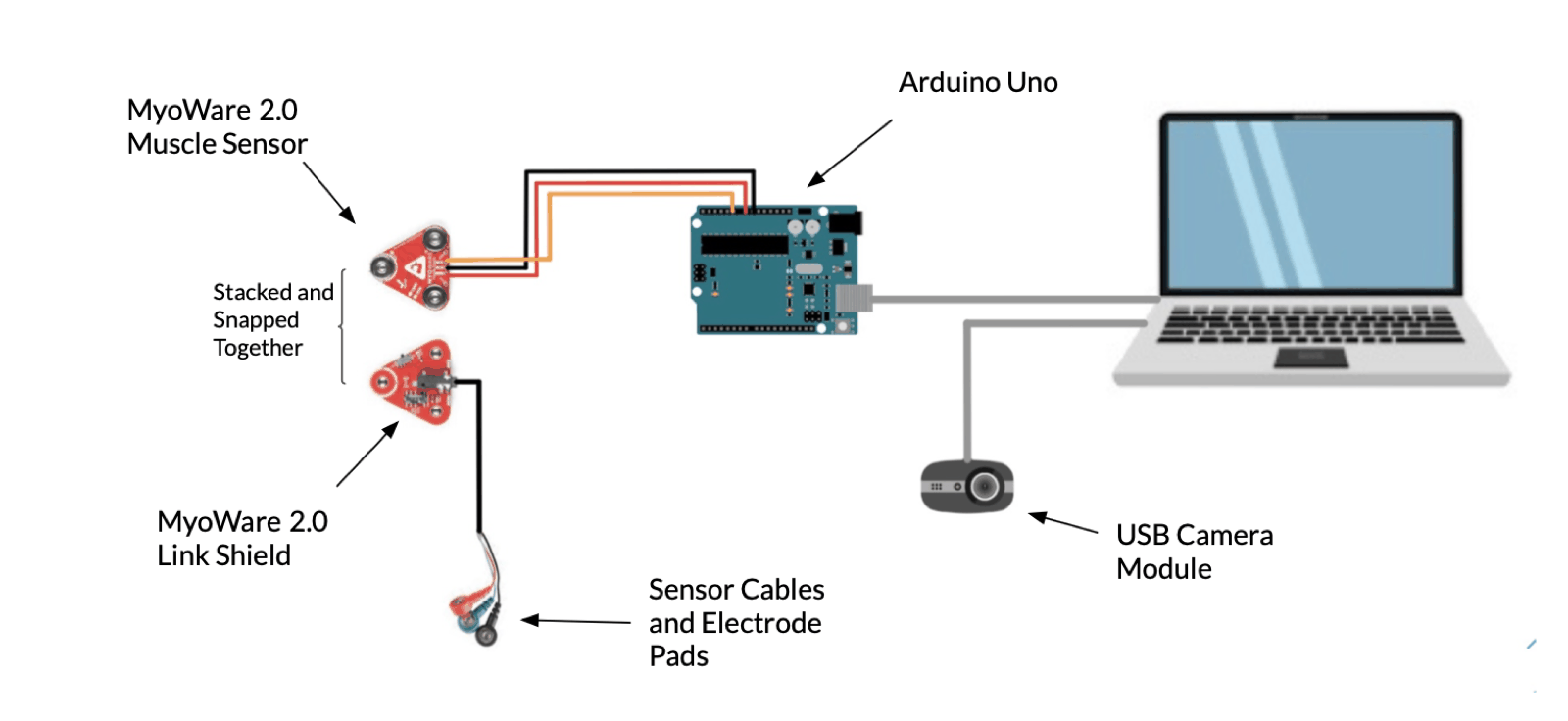
The goal was a device that stays out of the way and is easy to learn. I explored headset, headband and glasses form factors. The proposed design is a lightweight 3D-printed PLA piece that sits over one eye and rests on the ear. It holds three electrode pads, a camera, a battery, a microcontroller and a Bluetooth module. The study prototype used a headband, a USB camera and sensor cables.
User interface
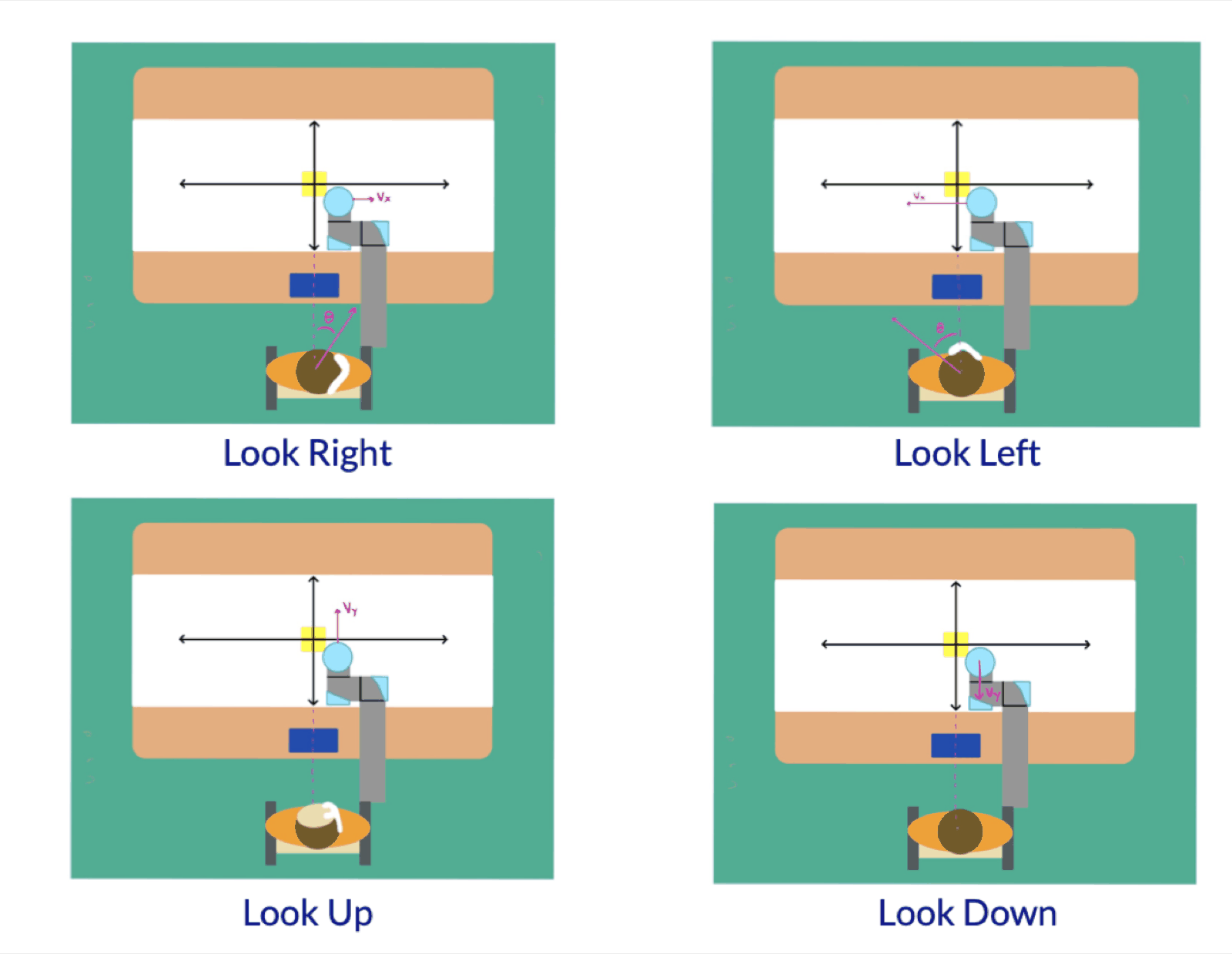
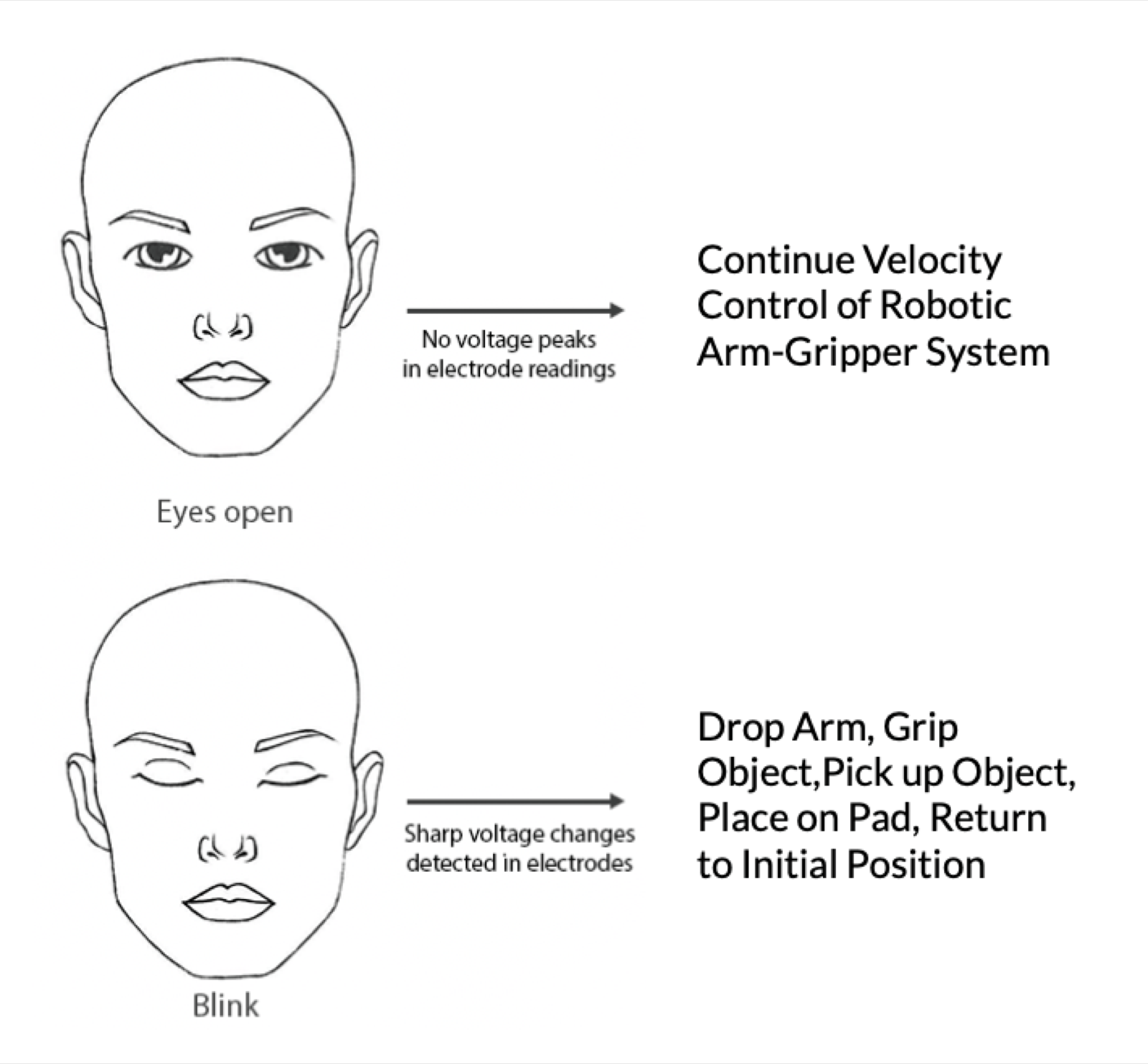
The arm moves on a plane 10 cm above the table. When the user looks left, right, up or down, the gripper moves the same way, and the farther they turn their head, the faster it goes. A deliberate strong blink, a tight voluntary squeeze that the system can tell apart from a normal blink, starts a pick-and-place sequence. The arm drops, grips, lifts, moves the object to a spot in front of the user, releases it and returns home.
System architecture
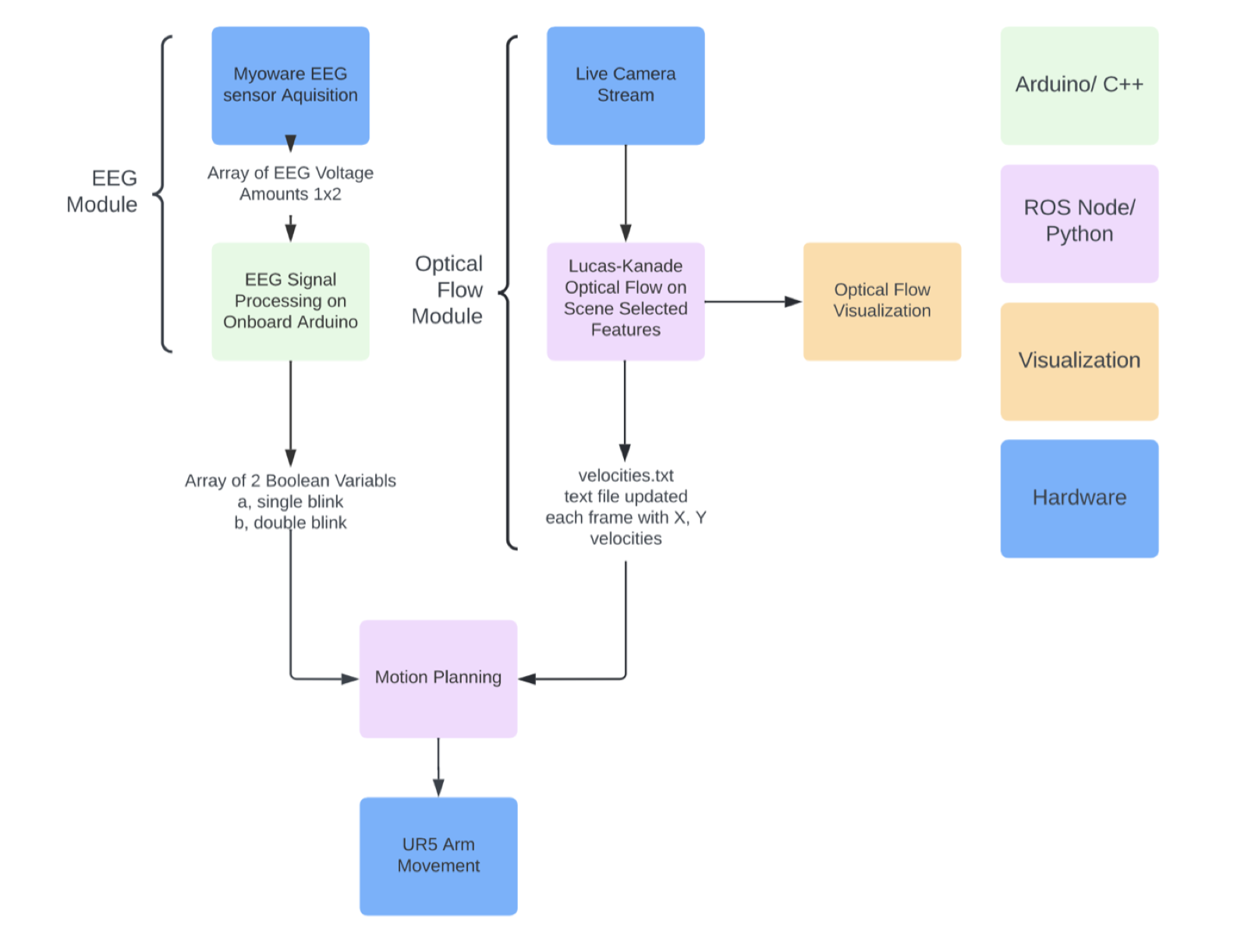
Two data streams feed the system. EMG comes from electrodes around the eye through an Arduino, and video comes from the head-mounted camera. Processing runs across Arduino C++, Python ROS nodes and a Python visualizer.
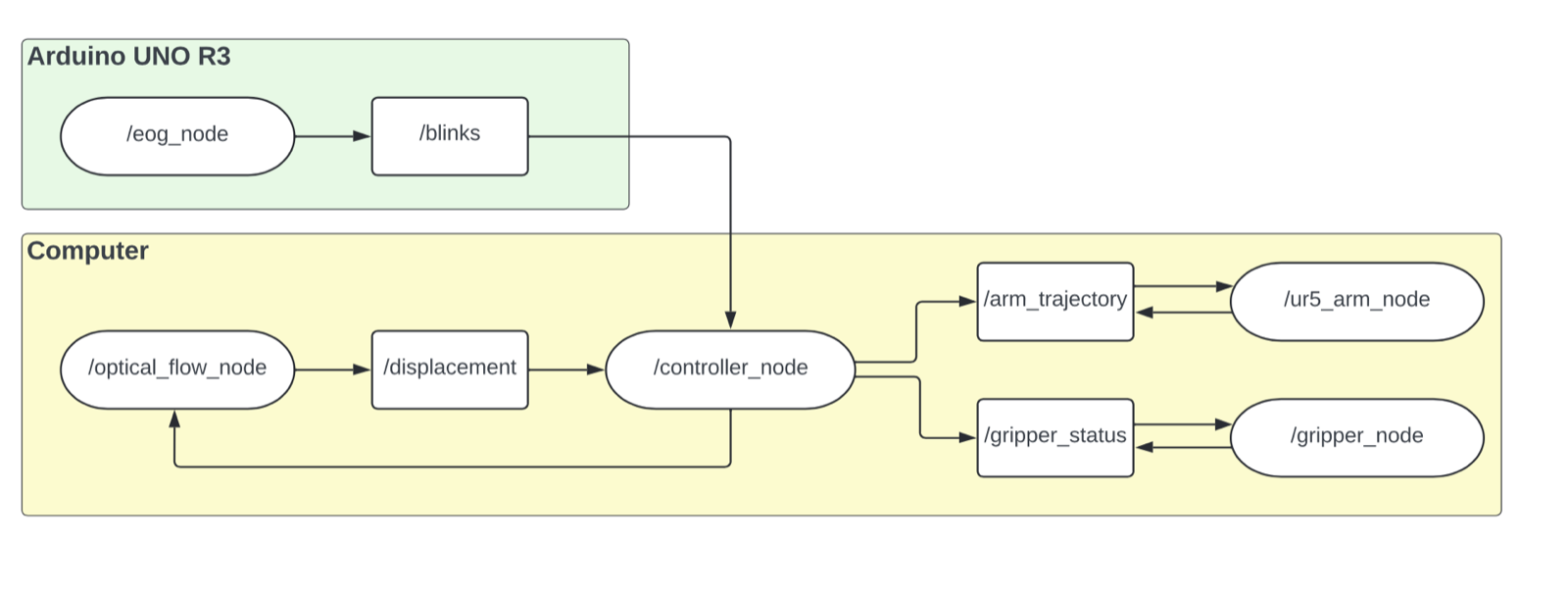
ROS graph
/eog_nodepublishes blink booleans./optical_flow_nodepublishes the camera's x/y displacement./controller_noderuns motion planning and publishes end-effector targets and gripper state./ur5_arm_nodesolves inverse kinematics, and/gripper_nodeactuates the gripper.
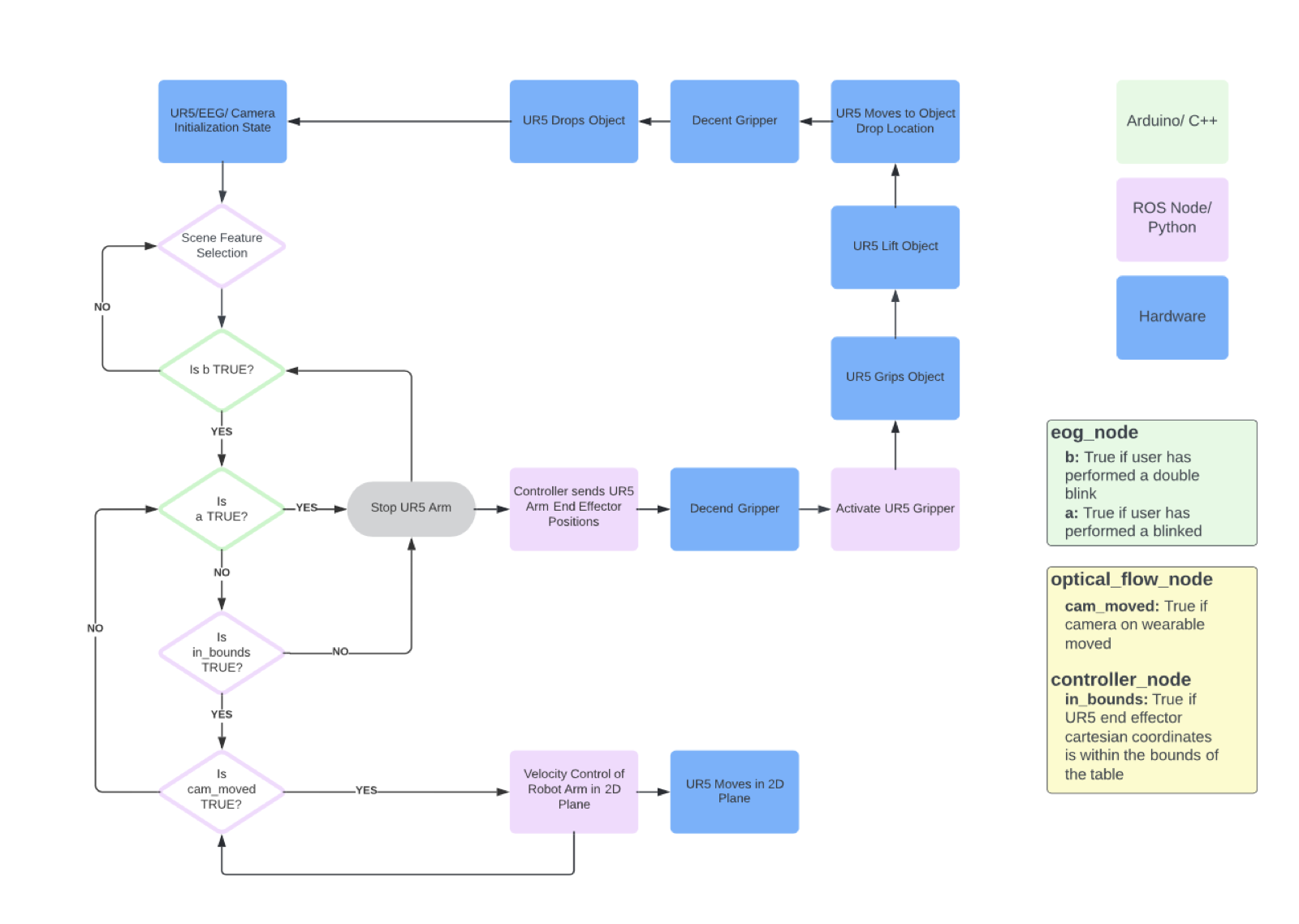
Motion-planning state machine
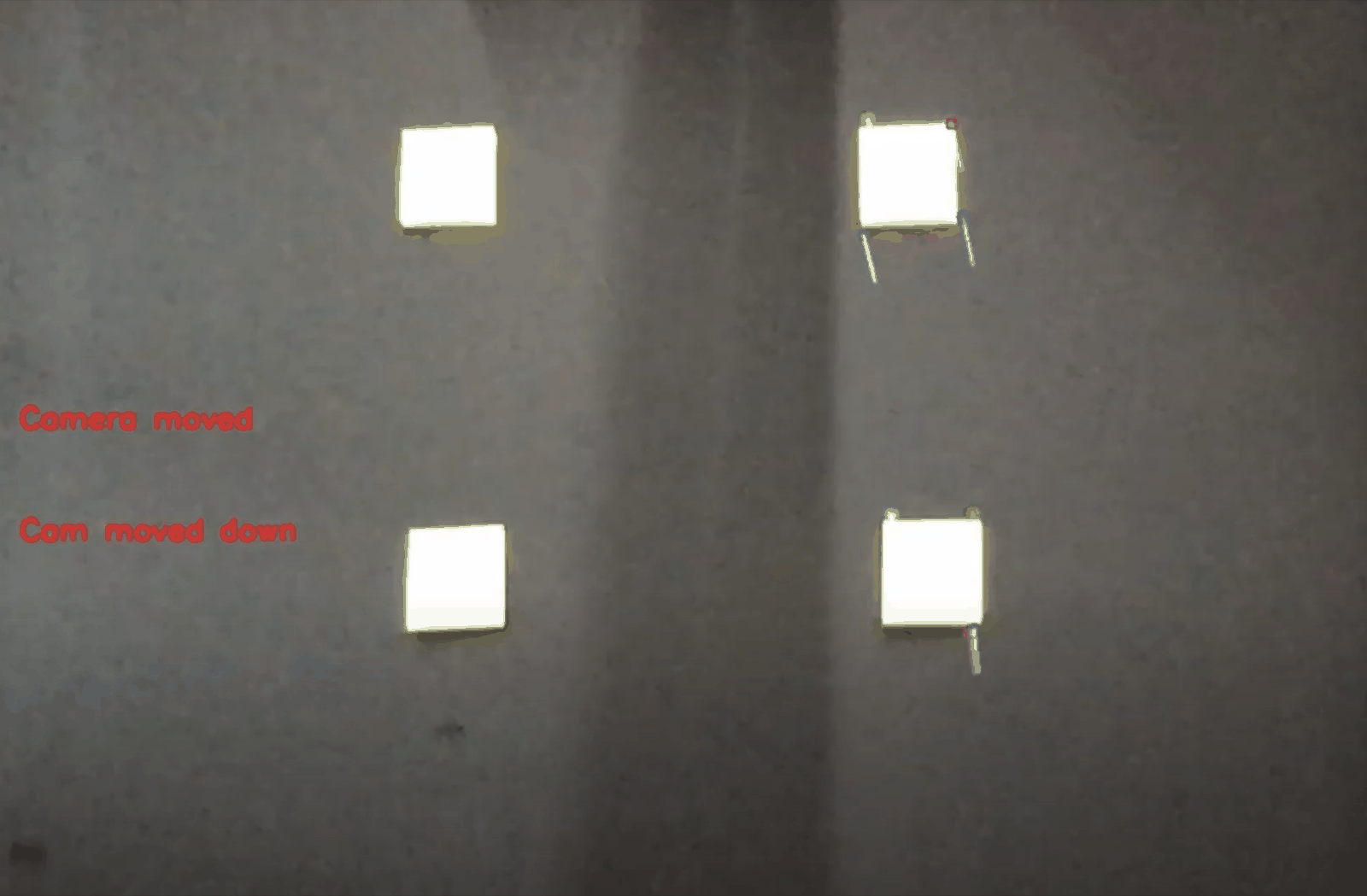
A double blink sets the reference frame. After that, the flow node tracks features and streams total displacement for velocity control. A blink, or reaching the edge of the table, stops the arm. The controller then sends a timed sequence of end-effector waypoints: descend 7 cm, grip, ascend, move to the drop-off point, release and return.
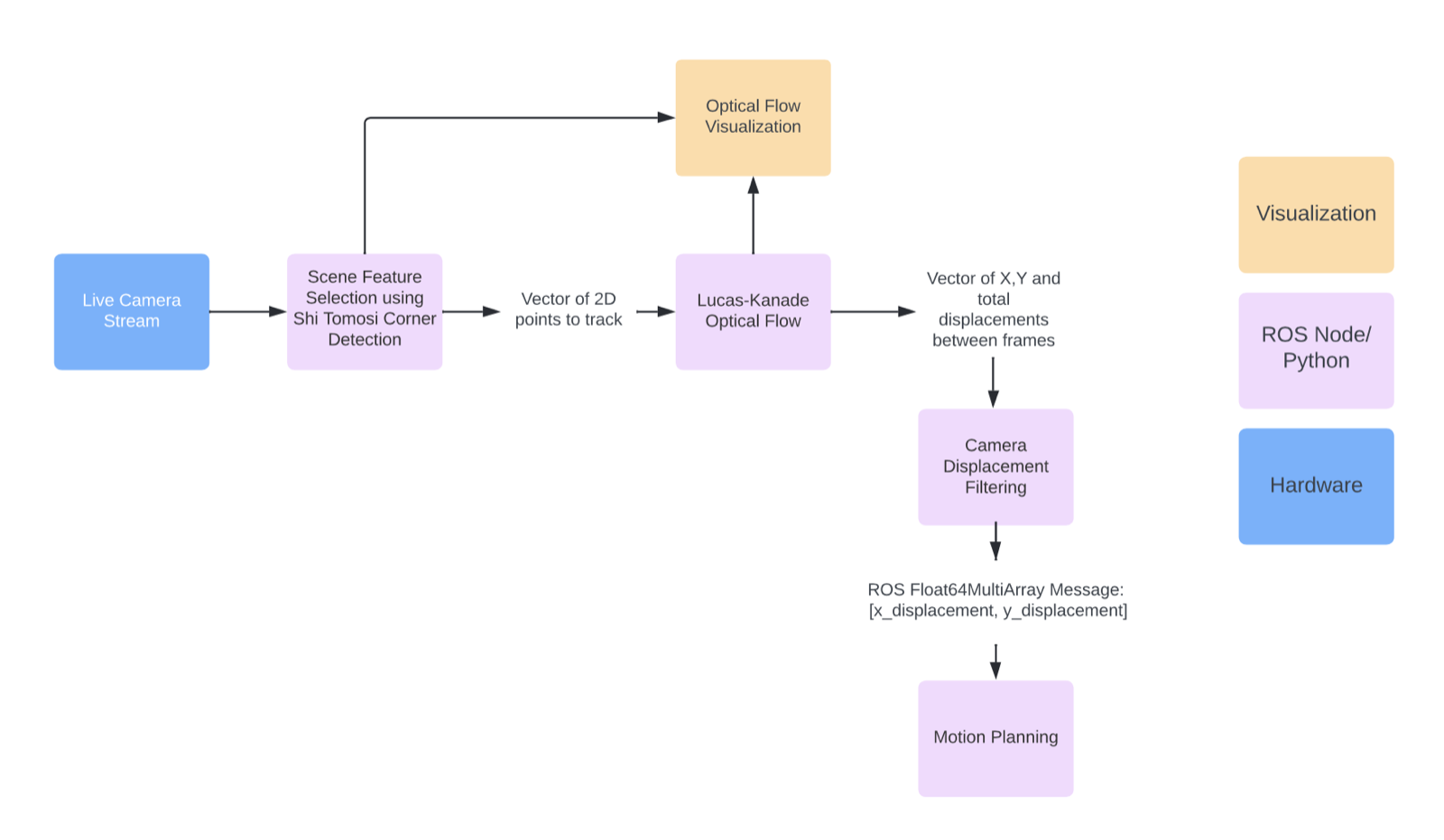
Optical-flow head tracking
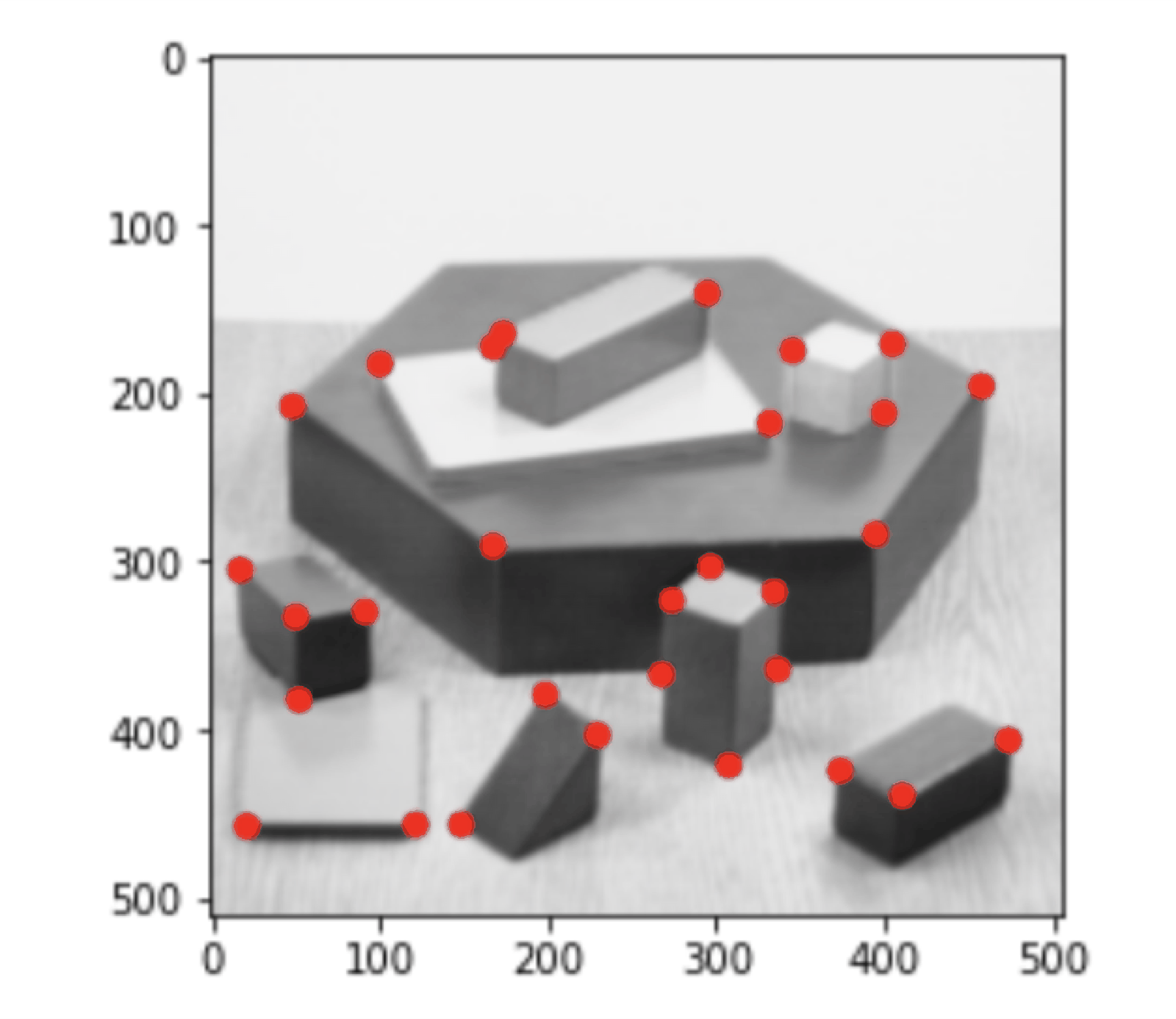
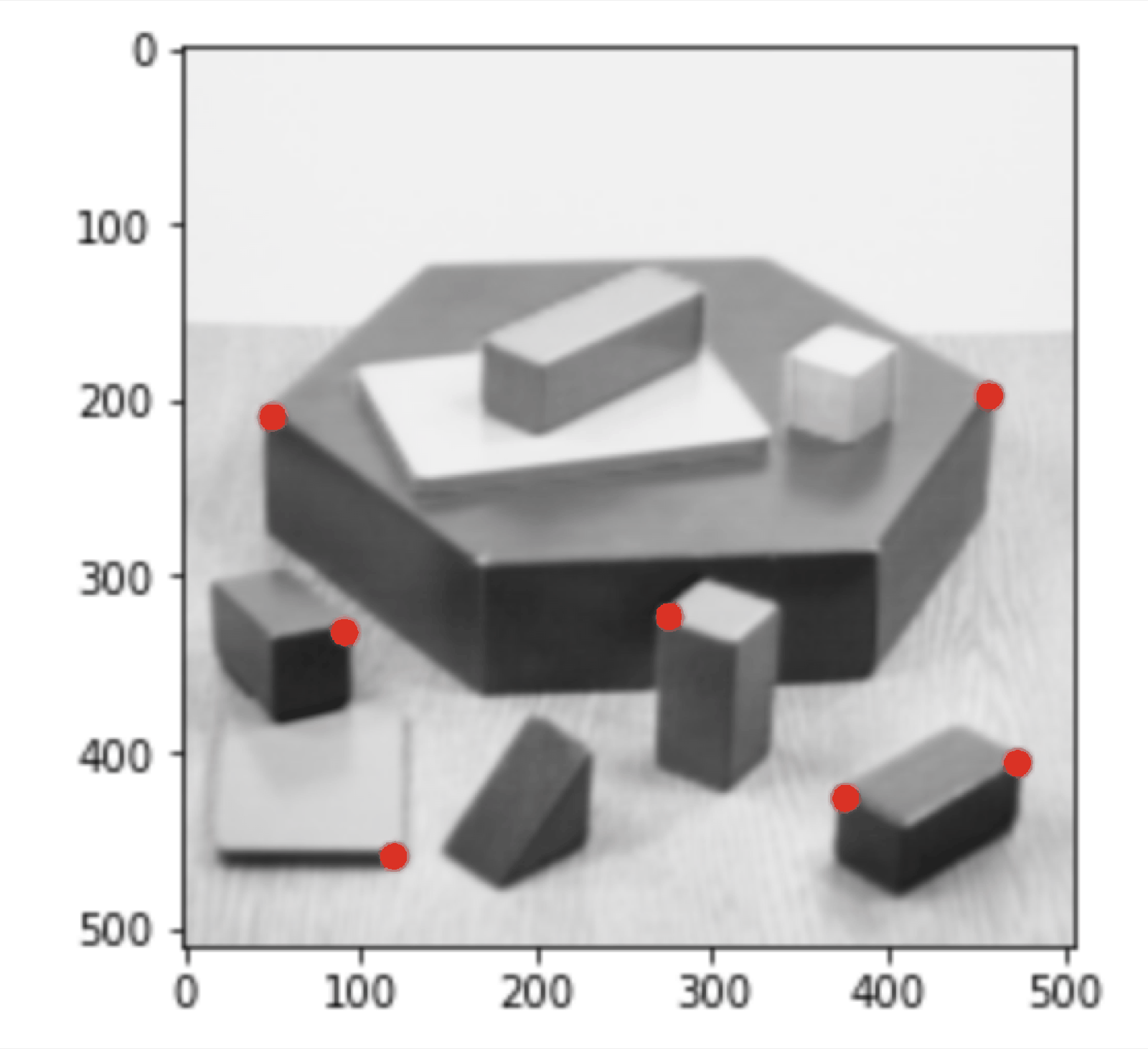
The camera records at 30 fps. On initialization, Shi-Tomasi corner detection (cv.goodFeaturesToTrack) picks 30 features at least 6 px apart, and pyramidal Lucas-Kanade (cv.calcOpticalFlowPyrLK) tracks them frame to frame. Per-frame displacement is clipped at 8 px, and total displacement is capped at 500 px. That range maps linearly to arm speeds of 0 to 6 mm/s.
I compared Shi-Tomasi against Harris corner detection. Harris was too slow for real-time control, so I chose Shi-Tomasi.
EMG blink detection
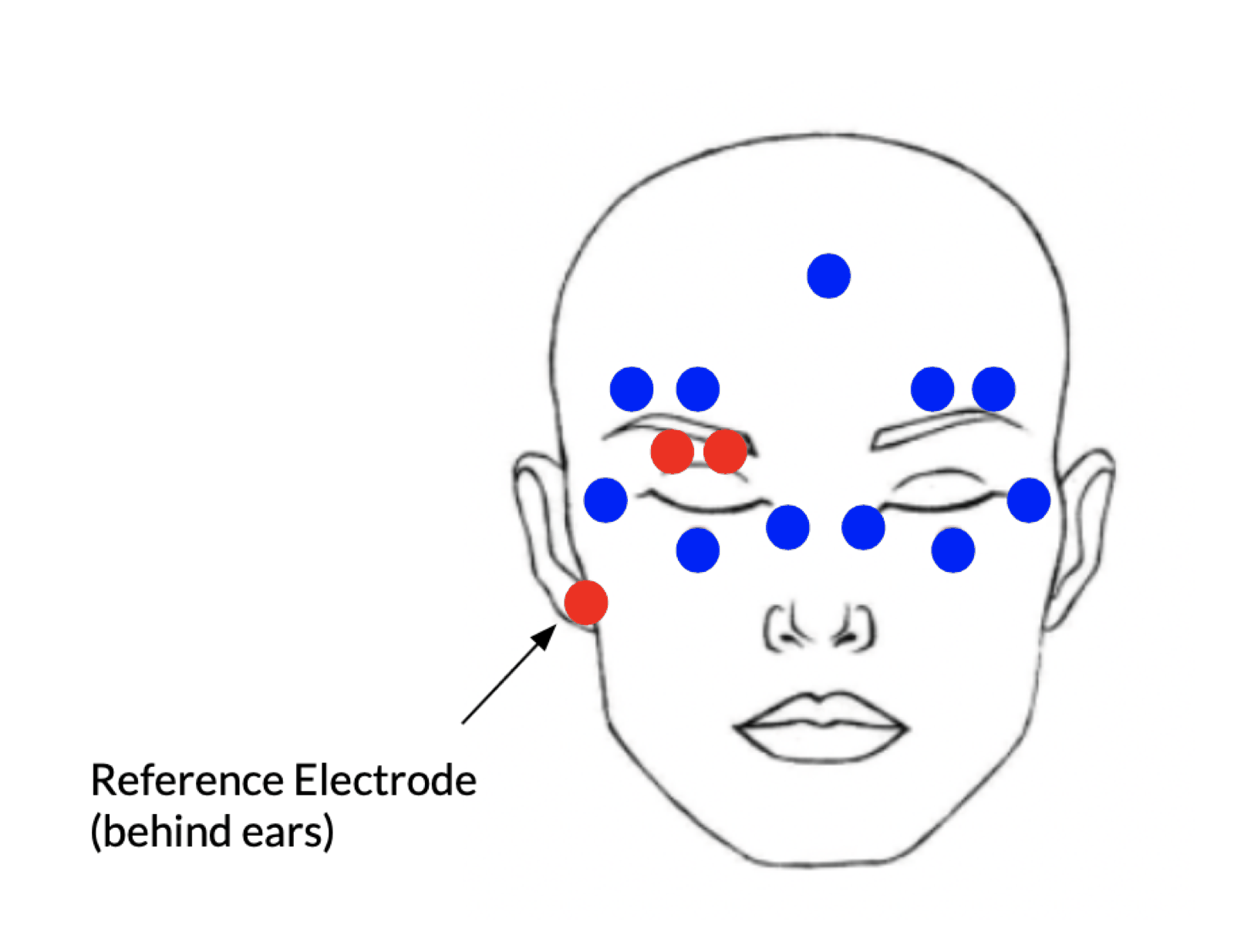
A MyoWare 2.0 muscle sensor and Link Shield on an Arduino Uno read three electrodes. Two sit on the levator palpebrae superioris, the muscle that opens and closes the upper eyelid, and a reference electrode sits behind the ear. Voltage spikes are classified as blinks and published to ROS. I also tested placement on the frontalis, the eyebrow muscle.
Experimental setup & results
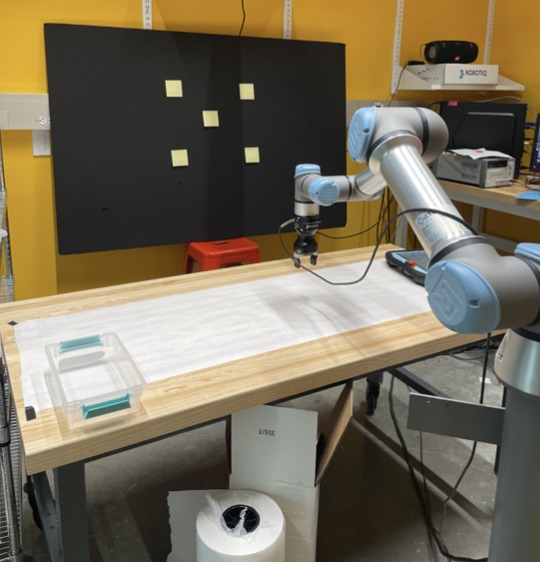
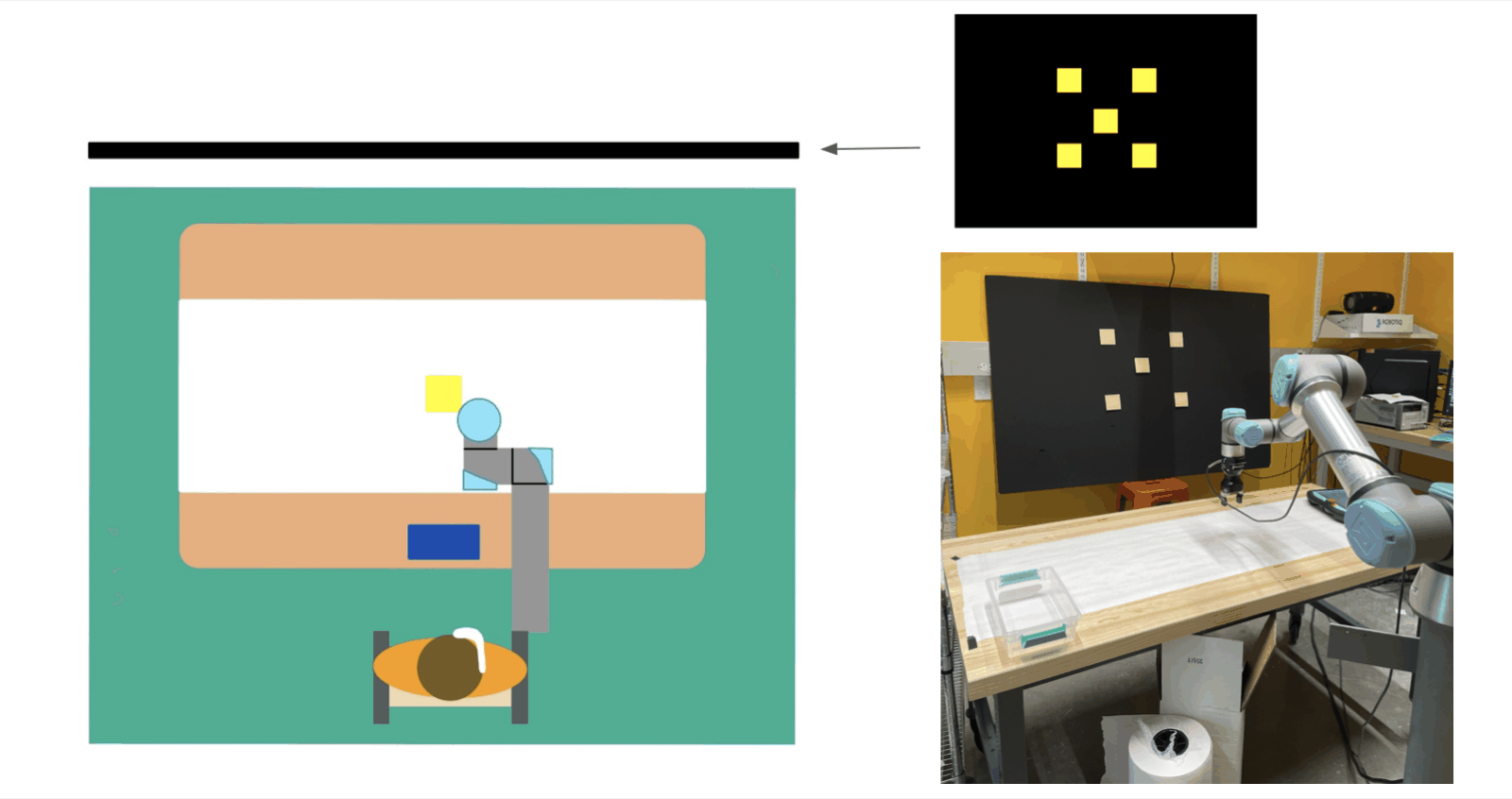
Preliminary experiments validated velocity control of a UR5e from head motion and blink-triggered pick-and-place. A black backdrop with high-contrast markers made feature detection more reliable. Arm control used Clark Teeple's Universal Robots ROS interface: its Cartesian trajectory handler ran the pick-and-place waypoints, and its twist handler sent velocity commands.
Challenges & future work
- Signal quality: eyelid EMG is in the microvolt range. Traditional EOG uses wet Ag/AgCl electrodes, which are hard for users with DMD to maintain. Fabricated electrodes (inkjet-printed, metal 3D-printed or silver-nanoparticle tattoo electrodes) could improve the signal-to-noise ratio.
- Placement robustness: the system needs to tolerate small electrode shifts. Machine-learning classifiers for facial-muscle activity are one option.
- Integration: a fully 3D-printed, wireless headset that holds the electrodes in a fixed position.